
BUY PROPERTY IN TURKEY · FOREIGN NATIONALS · ISTANBUL
A foreigner may buy property in Turkey — but two ceilings apply at once, and one of them is invisible without an enquiry.
Article 35 of the Land Registry Law, the thirty-hectare and ten per cent limits, title deed examination before payment, military security zones, purchase under a power of attorney, and how ownership relates to residence and citizenship.
Last updated: 9 August 2026 · Legislation check: Article 35 of the Land Registry Law and the Turkish Citizenship Law are cited as in force on this date. Monetary thresholds are fixed by regulation and are not quoted here.
Foreigners who buy property in Turkey usually discover the legal framework in the wrong order: first the purchase, then the questions. This article sets out the framework in the order that protects the buyer — what the law permits, what it limits, what must be examined before payment, and how ownership relates to residence and citizenship.
The rules are not obscure. Almost all of them sit in a single provision, Article 35 of the Land Registry Law, together with the regulations made under it. What makes the field difficult is that the commercial process moves faster than the legal one, and the buyer is often asked to pay before anything has been read.
Can Foreigners Buy Property in Turkey?
Whether a foreigner may buy property in Turkey is asked so often that it deserves a precise answer rather than a reassuring one. Under Article 35 of the Land Registry Law, citizens of countries determined by the President may acquire immovable property and limited rights in rem in Turkey. The reciprocity requirement that governed this field until 2012 was removed and replaced by that country-list system.
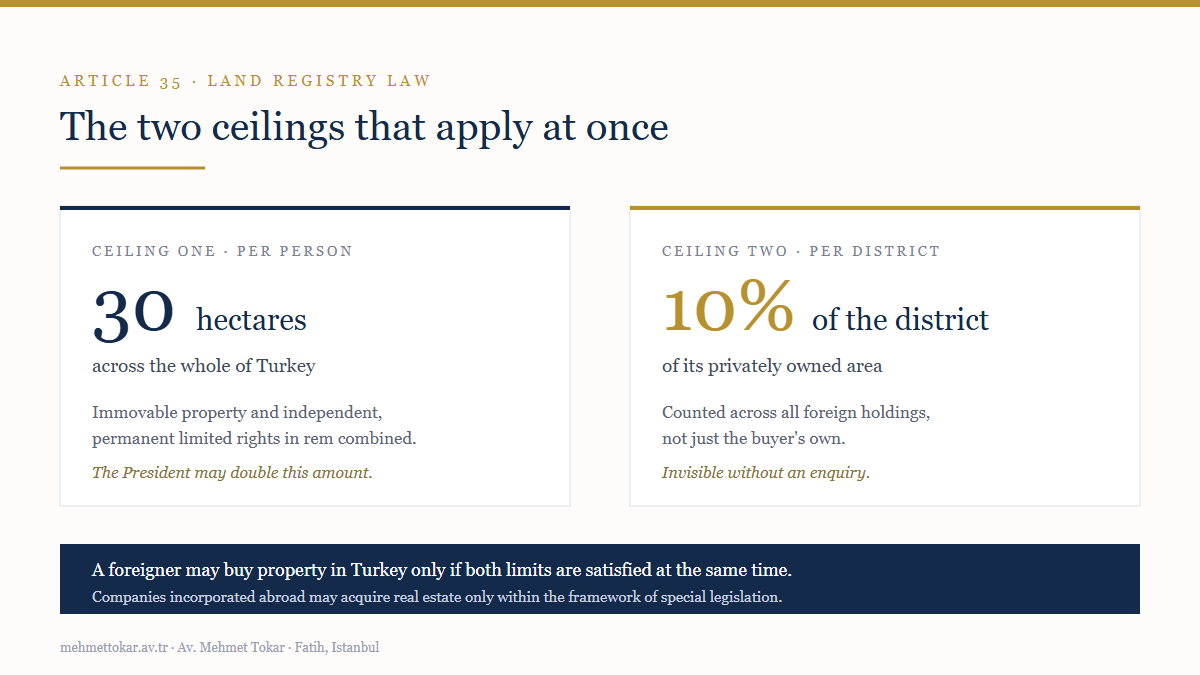
The permission is not unlimited, however. Two statutory ceilings apply at the same time, and most guides mention only the first of them.
Two Ceilings Apply When You Buy Property in Turkey
A foreign natural person may hold at most thirty hectares of immovable property and independent, permanent limited rights in rem across the whole of Turkey. Separately, the total may not exceed ten per cent of the privately owned area of the district in which the property lies. The second limit is the one that surprises buyers, because it is not about how much the buyer owns but about how much of that district is already in foreign hands.
The President is empowered to double the individual nationwide ceiling. Foreign commercial companies established under the laws of their own country may acquire property only within the framework of special legislation. Foreign legal entities that are not commercial companies cannot acquire property at all. That point matters when a purchase is structured through an offshore vehicle.
A company incorporated in Turkey is a different case, and the distinction is easy to miss. Under Article 36 of the same Law, companies established in Turkey in which foreign natural persons, foreign legal entities or international organisations hold fifty per cent or more of the shares — or have the power to appoint or remove the majority of those holding management rights — may acquire ownership of immovable property and limited rights in rem, in order to carry on the activities stated in their articles of association. Buying through a Turkish company is therefore possible, but it ties the acquisition to the company’s stated purpose.
Where the buyer intends to establish a mortgage rather than acquire ownership, these ceilings do not apply — Article 35 excludes the establishment of a mortgage in favour of foreign natural persons and of those commercial companies from the limits it sets.
Companies, Mortgages and the Duties That Follow
Two further duties in the same article are routinely overlooked. A foreign buyer of undeveloped land must submit the project to be developed on it for the approval of the relevant Ministry within two years; the approved project, with its start and completion dates, is recorded in the declarations section of the land register and monitored. And property acquired contrary to the article, used contrary to the purpose of acquisition, or held where no application was made within the period, is liquidated — the sanction is the loss of the property against its value, not a fine.
Title Deed Checks Before You Buy Property in Turkey
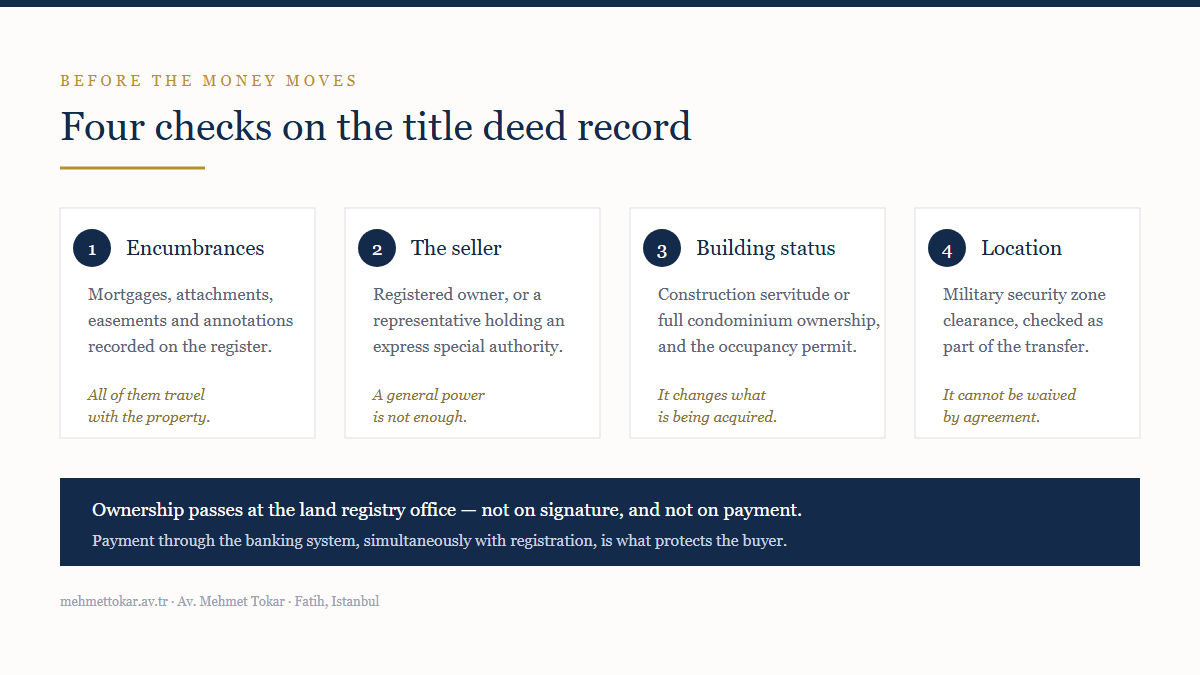
The land registry record can be examined by an interested party. Almost every dispute that follows a decision to buy property in Turkey is already visible in it. Before any money moves, four things are read: existing mortgages and attachments, easements and annotations, the identity and authority of the seller, and the legal status of the building.
That last item is the one non-lawyers underestimate. A property may be registered under a construction servitude rather than full condominium ownership, which means the building has not yet completed its formal process. It is not automatically a problem, but it changes what the buyer is actually acquiring and it should be a conscious decision rather than a discovery.
The seller must be the registered owner or a representative holding an authority that expressly covers the sale. A general authority is not enough; selling immovable property requires a special power.
Military Zones and Restricted Areas
Article 35 sets out how the check works. Maps and coordinates of military prohibited zones, military security zones and strategic areas are supplied by the Ministry of National Defence, and those of private security zones by the Ministry of the Interior, to the ministry to which the Land Registry and Cadastre General Directorate is attached — and land registry transactions are then conducted according to that data. For anyone planning to buy property in Turkey on the coast or near a border the restriction is real, and it cannot be waived by agreement between the parties.
For that reason a purchase contract signed before the location question is settled carries a real risk. Where a preliminary contract is used, it should deal expressly with what happens if the transfer cannot be completed for this reason.
How Ownership Passes When You Buy Property in Turkey
Those who buy property in Turkey acquire ownership at the land registry office, not on signature of a contract and not on payment. A contract made before a notary creates obligations between the parties but does not transfer title.
The practical consequence is that payment and registration should be simultaneous. Money moves through the banking system at the moment of registration. That protects the buyer, and it produces the paper trail a later citizenship or residence application will require.
Two preliminary steps are worth taking early, because they are the usual cause of a delay at the counter. A foreign buyer needs a Turkish tax number, obtained from the tax office or online on presentation of a passport, and in practice a Turkish bank account, which is what makes the payment traceable. Where the property is being bought with a citizenship application in mind, a valuation report from an authorised firm is also required, and it must be dated close to the transfer.
Buyers who pay in cash, or in instalments before registration, lose that protection. Every year a proportion of disputes involving foreigners begins with a payment made in a sales office against a receipt.
Buy Property in Turkey Through a Power of Attorney
It is entirely possible to complete the purchase without being in the country. An attorney can complete the transfer under a power executed before a Turkish consulate in the buyer’s country of residence. A power made before a local notary works too, once it has been apostilled and translated by a sworn translator.
Wording matters more than form. The authority must expressly cover the purchase, the signature of the transfer at the land registry, and any related steps such as obtaining a tax number or opening a bank account. A power drafted in general terms is regularly rejected at the counter.
The same instrument can be revoked, and revocation takes effect once it is notified through the notary system. Anyone who has given a broad authority to an agent or a developer and later has doubts should treat revocation as urgent rather than routine.
Property, Residence and Citizenship Are Three Different Things
A great deal of confusion — and a good deal of mis-selling — comes from treating ownership, residence and citizenship as one package. They are three separate legal routes with different bases, conditions and outcomes.
| Route | Legal basis | Core condition | Time element | Outcome |
|---|---|---|---|---|
| Property → short-term residence permit | Foreigners and International Protection Law, art. 31 | Ownership of immovable property plus the general permit conditions | Renewable permit periods | Right of residence, not nationality |
| Property → exceptional citizenship | Turkish Citizenship Law, art. 12 via art. 31/1(j) permit | Purchase at or above the threshold fixed by regulation, with valuation report | Three-year no-sale annotation on the title | Citizenship by presidential decision |
| Ordinary naturalisation | Turkish Citizenship Law, art. 11 | Language, means of support, good character, public order | Five years of uninterrupted residence | Citizenship on application |
The monetary threshold for the citizenship route, the valuation report requirement and the three-year no-sale annotation are set by regulation, not by the Law itself, and they have been changed more than once. For that reason no figure is quoted here; it should be confirmed at the time of purchase. What does not change is where the applications fail: a valuation that does not match the declared price, a payment that cannot be traced through the banking system, or a seller who does not qualify.
Costs Beyond the Price When You Buy Property in Turkey
The price agreed with the seller is not the whole cost. Title deed transfer fees, the mandatory earthquake insurance policy, the valuation report where one is required, sworn translation and notary charges, and in some municipalities a separate contribution all fall due around completion.
Annual property tax follows, assessed by the municipality, and a rental income from the property brings its own declaration obligations. None of these is unusual, but budgeting only for the headline figure is a common reason for the last stage of a transaction to stall.
Where the transaction forms part of a citizenship application, the payment route itself becomes evidence, so the costs should be met from traceable banking channels rather than settled informally.
What Goes Wrong Most Often
Four patterns account for most of the files that reach a lawyer after the event, and each of them begins before the decision to buy property in Turkey is completed. The first is payment before examination, described above. Second comes reliance on a translation of the contract that omits or softens a clause — the Turkish text governs.
The third is buying from a developer before the building has its occupancy permit, on the assumption that it will follow shortly. Fourth, the promise of a guaranteed rental return, which is a commercial undertaking of the seller and is only as good as the seller; it does not attach to the property.
None of these is exotic. Each is visible in the documents before completion, which is why the examination stage is worth more than any step taken afterwards.
Conclusion
Three points carry most of the weight. Ownership passes at the land registry and nowhere else, which means payment and registration belong together. Two ceilings apply at once — thirty hectares nationwide and ten per cent of the district — and the second is invisible to the buyer without an enquiry. And ownership, residence and citizenship are three separate routes; a property purchase can support the second and the third, but it produces neither on its own.
A buyer who reads the land registry record, confirms the seller’s authority, settles the military-zone question and pays through the banking system at the moment of transfer has removed the great majority of the risk. Everything after that is negotiation. Anyone preparing to buy property in Turkey is well advised to spend on the examination what they would otherwise spend on the dispute.
Frequently Asked Questions
Can foreigners buy property in Turkey?
Yes, subject to limits. Citizens of countries determined by the President may acquire real estate and limited rights in rem. A foreign natural person may hold at most thirty hectares nationwide, and the total may not exceed ten per cent of the privately owned area of the district.
How much land can one foreigner buy in Turkey?
Thirty hectares across the whole country under Article 35 of the Land Registry Law, with the additional district ceiling of ten per cent. The President is empowered to double the individual ceiling.
Can a foreign company buy property in Turkey?
Only within the framework of special legislation. Commercial companies with legal personality established under the laws of their own country may acquire real estate only where a special statute allows it; other foreign legal entities cannot acquire property at all.
Does buying a flat give me a residence permit?
Property ownership can support a short-term residence permit application, but it is a separate application with its own conditions on health insurance, address registration and income. Ownership alone is not a permit.
Do I have to come to Turkey to complete the purchase?
No. The transfer can be completed under a power of attorney executed before a Turkish consulate, or before a local notary and then apostilled and translated. The authority must expressly cover the purchase.
What is the single most common mistake?
Paying before the land registry record has been read. Mortgages, attachments, annotations and construction servitudes are all visible in the record, and every one of them is cheaper to discover before the money moves than after.
Contact
You can write to hukuk@mehmettokar.av.tr or use the contact page. For the wider framework see Legal Services for Foreigners in Turkey, and for the Turkish-language overview see Yabancılar Hukuku. Official sources: tkgm.gov.tr and mevzuat.gov.tr.