
Lawyer for Individual Applications · Practice Area
An individual application lawyer usually becomes involved when all legal remedies have been exhausted; this is, in fact, a prerequisite. An individual application to the Constitutional Court is the final domestic remedy for violations of fundamental rights.
From application requirements and admissibility assessment to the preparation of the written application and compensation for a violation of rights.
Who may apply, at which stage and within what time limit.
- Right of individual application
- Application requirements
- Exhaustion of ordinary remedies
- 30-day application deadline
Which violations may be raised and how the written application should be structured.
- Which violations of rights
- Preparation of the written application
- Admissibility criteria
- Constitution of the Republic of Türkiye (Anayasa)
The binding effect of a finding of a violation and its consequences.
- Binding effect of decisions
- Compensation for a violation of rights
- Discretion of the medical practitioner — Constitutional Court decision
Related Practice Areas and Legislation
The path to an individual application often involves criminal proceedings or a compensation case.
What Does a Lawyer for Individual Applications Do?
An individual application lawyer first checks whether the ordinary avenues of appeal and review have been duly exhausted. Applications submitted without satisfying this requirement are dismissed without examination of the merits.
The constitutional right concerned and the circumstances in which the violation occurred are then established in concrete terms. An individual application lawyer monitors the thirty-day time limit and prepares the written application with due regard to the admissibility criteria.
Individual Application to the Constitutional Court
An individual application to the Constitutional Court is a final and effective legal remedy available to individuals whose fundamental rights and freedoms have been violated by public authorities. Introduced into the Turkish legal system through the constitutional amendment adopted in 2010, the right of individual application became operational on 23 September 2012.
Mehmet Tokar, a lawyer practising in Istanbul, provides clients with comprehensive legal advice and application preparation services throughout the individual application process before the Constitutional Court. Assistance is provided at every stage, from assessing application requirements and preparing the written application to monitoring proceedings and handling post-decision procedures.
Right of Individual Application
Under Article 148 of the Constitution, everyone may apply to the Constitutional Court on the grounds that any of their fundamental rights and freedoms guaranteed by the Constitution and falling within the scope of the European Convention on Human Rights has been violated by public authorities. This right applies both to Turkish citizens and to foreign nationals residing or present in Türkiye.
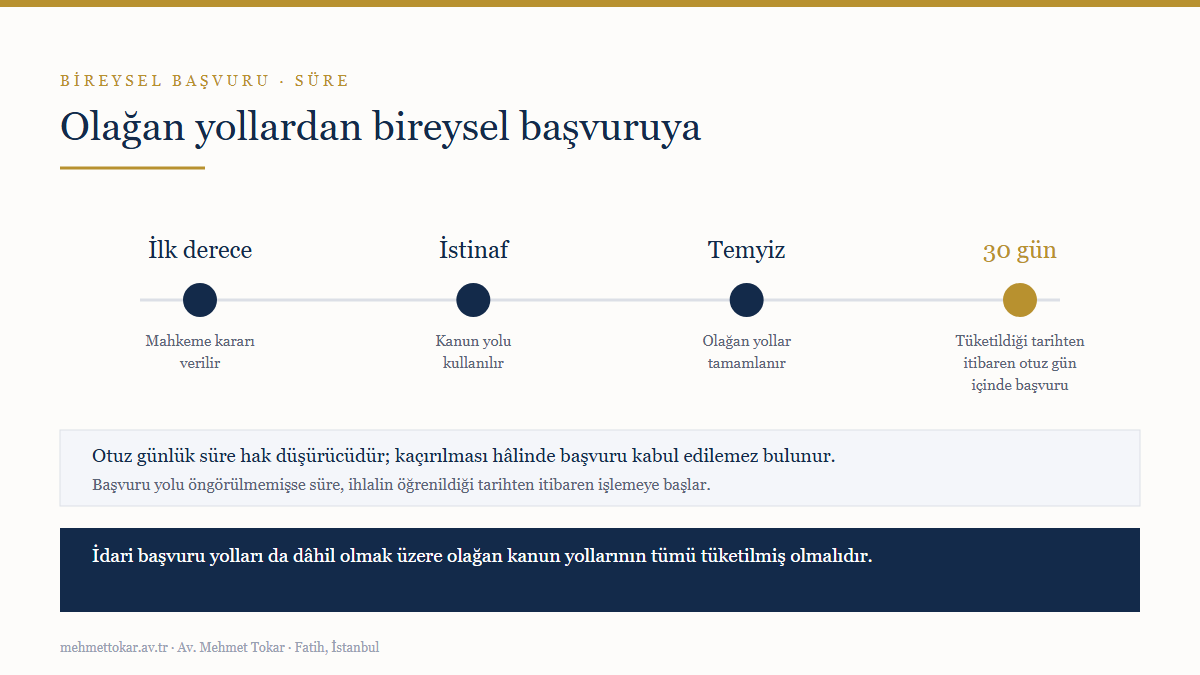
An individual application is an exceptional legal remedy available after the exhaustion of ordinary remedies. Accordingly, the proceedings before the court of first instance, the appeal (istinaf) and the appeal on points of law (temyiz) must first have been completed.
Application Requirements
Exhaustion of Ordinary Remedies
To lodge an individual application, the applicant must have exhausted all ordinary avenues of appeal and review. This requirement means that the ordinary courts must first be given an opportunity to examine and resolve the alleged violation. The available avenues of appeal and appeal on points of law must be pursued, and administrative remedies are also expected to have been exhausted.
30-Day Application Deadline
An individual application must be lodged within thirty days from the date on which the available remedies were exhausted or, where no remedy is provided, from the date on which the applicant became aware of the violation. This is a strict time limit, and failure to comply with it renders the application inadmissible. Correctly calculating the time limit and submitting the application on time are therefore essential.
Which Violations of Rights May Be Raised in an Application?
The principal violations of rights that may be raised in an individual application are as follows:
Right to life: Failure by the State to fulfil its obligation to protect the right to life.
Prohibition of torture and ill-treatment: Ill-treatment in police custody or prison.
Right to liberty and security: Unlawful pre-trial detention and police custody.
Right to a fair trial: Failure to conduct judicial proceedings within a reasonable time, denial of access to a court and restrictions on the right to defence.
Right to respect for private life: Failure to protect personal data and interference with family life.
Freedom of expression: Violation of the freedom to express thoughts and opinions.
Right to property: Disproportionate interference with the right to property and failure to pay expropriation compensation.
Preparation of the Written Application
The written application must be prepared in accordance with the format prescribed by the Constitutional Court. It must clearly specify the applicant’s identity details, the right violated, the act giving rise to the violation, information concerning the exhaustion of remedies and the redress sought.
Supporting the written application with legal arguments, referring to the case law of the Constitutional Court and the European Court of Human Rights, and substantiating the alleged violation with concrete evidence are important for the assessment of the application. A lawyer can prepare the written application with due regard to the requirements for admissibility and examination of the merits.
Admissibility Criteria
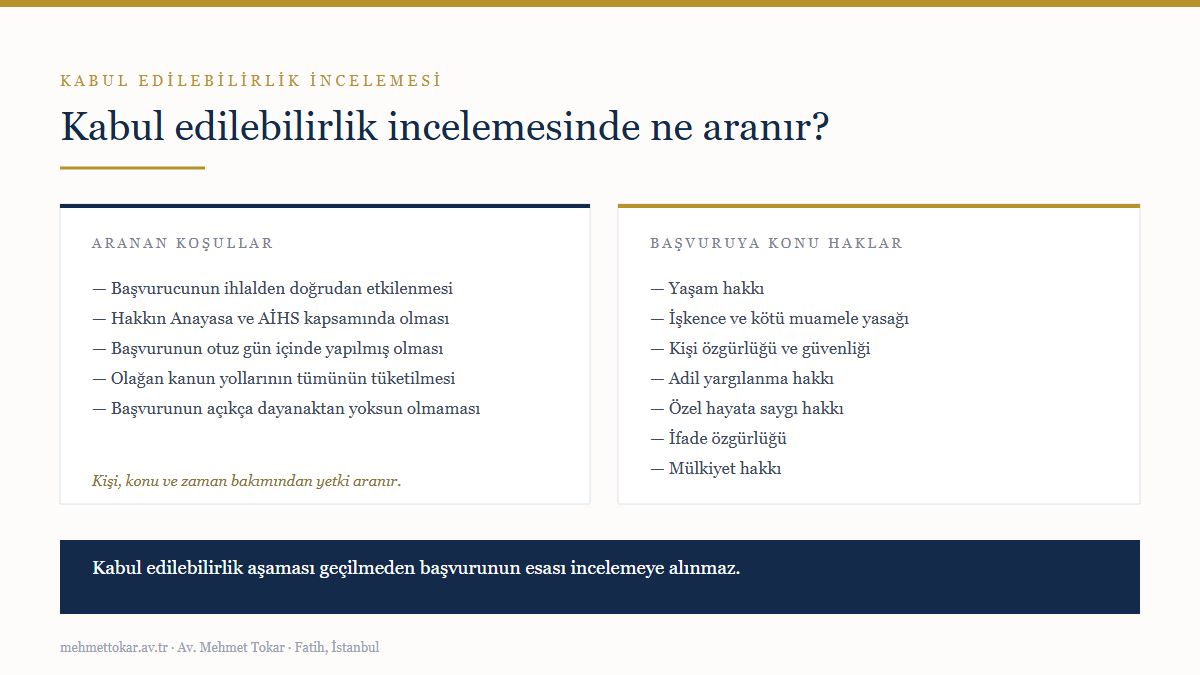
The Constitutional Court first examines individual applications in terms of admissibility. The admissibility criteria are as follows:
Jurisdiction ratione personae: The applicant must have been directly affected by the violation.
Jurisdiction ratione materiae: The alleged violation must concern a right falling within the scope of both the Constitution and the European Convention on Human Rights.
Jurisdiction ratione temporis: The application must have been lodged within the 30-day time limit.
Exhaustion of remedies: All ordinary avenues of appeal and review must have been pursued.
Not being manifestly ill-founded: The application must be supported by concrete evidence and legal arguments.
Binding Effect of Constitutional Court Decisions
Decisions delivered by the Constitutional Court following individual applications are binding on the legislative, executive and judicial bodies. The relevant courts and administrative authorities are required to comply with decisions establishing a violation. Where the Court finds a violation, it may order the measures necessary to eliminate the violation and its consequences.
Compensation Following a Finding of a Violation
Where the Constitutional Court finds a violation of rights following an individual application, it may award the applicant pecuniary and non-pecuniary damages. The quantum of damages is determined according to the nature of the violation, the harm suffered by the applicant and considerations of equity.
A finding of a violation may also constitute a ground for reopening judicial proceedings. Where the violation arises from a court decision, the relevant court may reopen the proceedings and deliver a decision that eliminates the violation and its consequences.
Obtain Legal Assistance for an Application to the Constitutional Court
If you believe that your fundamental rights and freedoms have been violated, obtaining legal assistance from a lawyer during the individual application process is important. We are available to provide legal assistance in assessing application requirements, preparing the written application and monitoring proceedings.
Contact us and arrange an appointment regarding your individual application to the Constitutional Court.