
WORK PERMIT IN TURKEY · FOREIGN NATIONALS · ISTANBUL
A work permit in Turkey belongs to a job, not to a person — change the employer and you start again.
Who applies and where, the durations set by the International Labour Force Law, the pre-permission required in health and education, the statutory grounds for refusal and cancellation, and why a residence permit gives no right to work.
Last updated: 9 August 2026 · Legislation check: Articles 7 to 15 and Article 23 of the International Labour Force Law (no. 6735) are cited as in force on this date. Administrative fines are revalued annually and are not quoted here.
The most consequential fact about a work permit in Turkey is structural rather than procedural: it attaches to a particular employer, workplace and job. An employee who moves to a better offer does not carry the permit across, and an application made for the new employer is assessed as a first application.
This article sets out who applies and where, how long each permit lasts, when pre-permission is required, and the statutory grounds on which an application is refused or a permit later cancelled.
Who Applies for a Work Permit in Turkey, and Where
An application for a work permit in Turkey made inside the country goes directly to the Ministry under Article 7 of the International Labour Force Law. Applications made from abroad go to the Turkish embassy or consulate in the country of nationality or lawful residence, which forwards them to the Ministry. An authorised intermediary institution may also file the application.
Extension applications for a work permit in Turkey have their own window. They may be made from sixty days before the permit expires and, in every case, before it expires. An extension application filed after expiry is refused — there is no discretion in the provision, and this single sentence accounts for a large share of the files that reach a lawyer.
Where the permit is granted on an application made from abroad, Article 12 requires the foreigner to come to Turkey within six months of the date the permit takes effect. A permit that is not used within that period is cancelled.
Duration: What the Law Actually Grants
Article 10 sets the pattern for every work permit in Turkey. A first permit is granted for at most one year, and it cannot exceed the length of the employment or service contract. It is valid for a specified job at a specified workplace belonging to a named employer, or at that employer’s workplaces in the same line of business.
A first extension with the same employer may be granted for up to two years, and later extensions for up to three. An application to work for a different employer, however, is assessed under the first-application rule — the accumulated years do not carry over.
| Stage | Maximum duration | Tied to | Note |
|---|---|---|---|
| First permit | One year | A named employer, workplace and job | Cannot exceed the length of the employment contract |
| First extension | Two years | The same employer | Applied for before the permit expires |
| Later extensions | Three years | The same employer | Each extension is assessed afresh |
| New employer | Treated as a first application | The new employer | The permit does not travel with the employee |
| Turquoise Card | Indefinite after the transition period | Qualification, not a single job | First three years are a transition period |
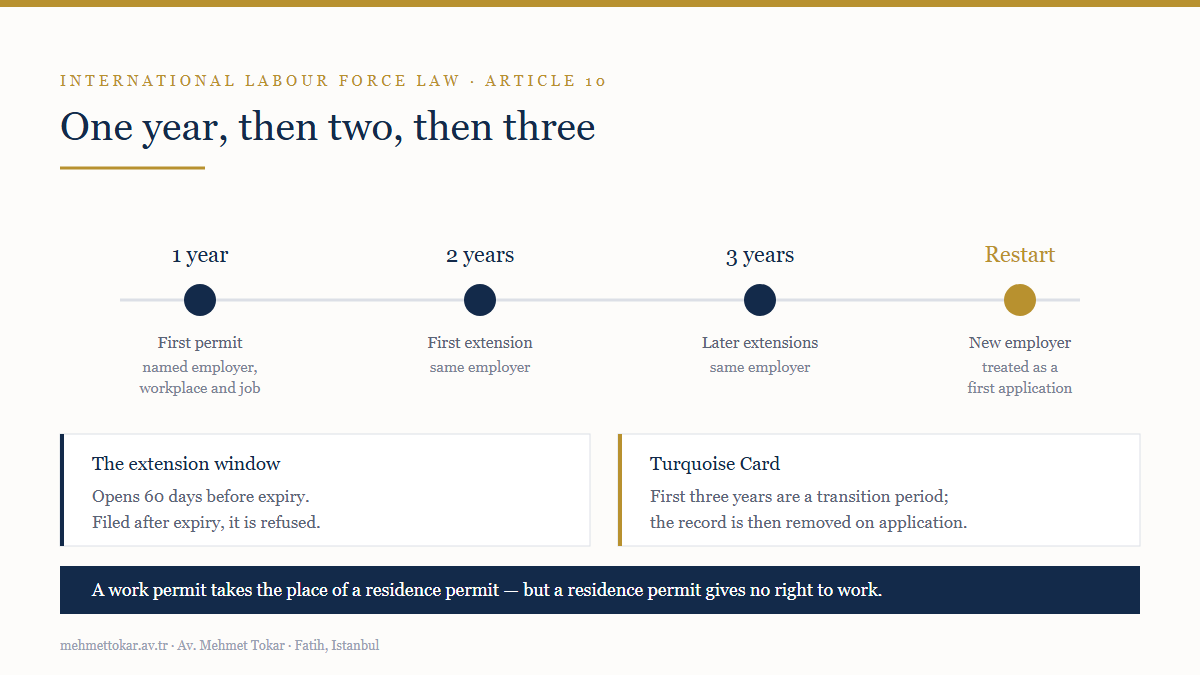
The Turquoise Card in Article 11 works differently. It is granted on the basis of education, professional experience, contribution to science and technology and the effect of the person’s activity or investment on the economy and employment. Its first three years are a transition period; where the card has not been cancelled during that period, the transition record is removed on application and the card becomes indefinite.
Pre-Permission, Exemptions and the Residence Trap
Some sectors add a step before a work permit in Turkey can be considered. Article 8 requires pre-permission for foreigners who will work in health and education services requiring professional qualification. The Ministry of Health and the Ministry of National Education grant it, and the occupations concerned are determined by the Ministry after taking their opinion.
Article 13 provides for a work permit exemption, applied for through the same channels. Its sixth paragraph is the one to note: time spent under an exemption is not taken into account when calculating lawful work permit or residence permit periods. An exemption keeps the activity lawful; it does not build up time towards anything.
The same article exempts certain roles from the permit requirement altogether — among them board members of joint stock companies established under the Commercial Code who do not reside in Turkey, partners of other companies who hold no management title, and cross-border service providers whose activity in Turkey does not exceed ninety days within any one hundred and eighty.
Article 12 contains the trap that catches most people. A work permit or exemption takes the place of a residence permit under Article 27 of Law no. 6458 — but the reverse is not true. Holding a residence permit for any other reason gives no right to work at all. Working on a student or family permit is unlawful employment, whatever the permit says on its face.
Why a Work Permit in Turkey Is Refused
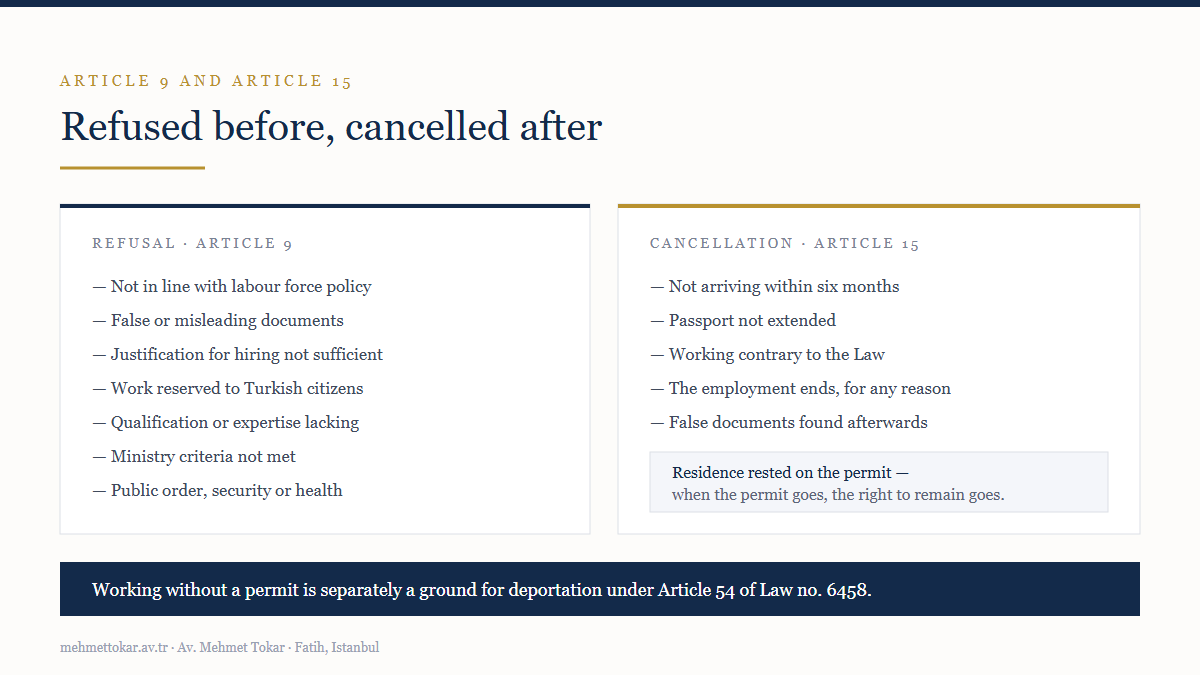
Article 9 lists the grounds on which a work permit in Turkey is refused. An application fails on any of the following:
- the application does not accord with international labour force policy
- false or misleading information and documents were used
- the justification for employing a foreigner is not considered sufficient
- the work or profession is reserved to Turkish citizens by other laws
- the foreigner is found to lack the necessary qualification and expertise
- the evaluation criteria set by the Ministry are not met
- the Ministry of the Interior reports that the person falls within Articles 7, 15 or 54 of Law no. 6458
- there is an objection on grounds of public order, public security or public health
In practice the third ground does most of the work. “The justification is not sufficient” is where an application fails when the employer has not explained why this role requires this person, and it is answered with evidence about the role rather than adjectives about the candidate.
Cancellation After the Permit Is Granted
A work permit in Turkey does not last beyond its own conditions. Article 15 provides that a permit or exemption loses validity when its term ends or the Ministry cancels it. Cancellation follows, among other things, from:
- failing to come to Turkey within six months of validity
- the passport or equivalent document not being extended
- a finding that the foreigner has worked contrary to the Law
- the employment ending, for any reason
- a later finding that the application was made with false or misleading information
The fourth of those is the one employers overlook. When employment ends, the permit does not simply lie dormant — it becomes liable to cancellation, and the foreigner’s right of residence, which rested on the permit under Article 12, goes with it.
Compliance is checked in the field rather than on paper. Article 23 provides for inspection by Ministry labour inspectors and by inspectors and auditors of the Social Security Institution, and public authorities and law enforcement report what they find during their own inspections.
Practical Points
Diary the extension window for every work permit in Turkey. Sixty days before expiry is the opening; expiry is the deadline; after that the application is refused.
Treat a job change as a new file. A work permit in Turkey does not move with the employee, and starting the new role before the new permit is granted is unlawful employment.
Keep the passport valid well beyond the work permit in Turkey, since a passport that is not extended is itself a cancellation ground.
Do not rely on a residence permit as a right to work. It is not one, and working without a permit is separately a ground for deportation under Article 54 of Law no. 6458.
What a Work Permit in Turkey Depends On
The provisions are short and unusually concrete. Applications go to the Ministry or through a consulate; the first permit runs for a year and is tied to one employer, one workplace and one job; extensions reach two and then three years with that employer; and an approach to a new employer starts the sequence again. Around that framework sit the pre-permission requirement in health and education, the exemption regime, and the Turquoise Card for those whose qualifications carry them beyond a single post.
Most disputes are avoidable. They arise from an extension filed after expiry, from a role begun before the new permit was issued, from a passport allowed to lapse, or from an assumption that a residence permit carries a right to work. Where the employment relationship itself is in question, the immigration and the labour sides of the file should be handled together, because a finding of unlawful work reaches both the permit and the right to remain.
Frequently Asked Questions
Who applies for a work permit in Turkey — the employer or the employee?
In the ordinary case the application is filed for the foreigner in respect of a named employer, either directly with the Ministry inside Turkey or through a Turkish embassy or consulate abroad. An authorised intermediary institution may also file it.
How long is a first work permit in Turkey valid?
A first work permit in Turkey runs for at most one year, and it cannot exceed the length of the employment contract. It is valid for a specified job at a specified workplace belonging to that employer.
Can I move to another employer on the same permit?
No. An application to work for a different employer is assessed as a first application under Article 10, and starting the new role before the new permit is granted is unlawful employment.
When can I apply to extend a work permit in Turkey?
From sixty days before the permit expires, and in every case before it expires. Article 7 provides that extension applications made after expiry are refused.
Does a residence permit let me work?
No. Article 12 provides that a work permit in Turkey takes the place of a residence permit, but that holding a residence permit for another reason gives no right to work.
What is a Turquoise Card?
A work permit in Turkey granted under Article 11 on the basis of education, professional experience and economic contribution. Its first three years are a transition period, after which the transition record is removed on application and the card becomes indefinite.
Contact
You can write to hukuk@mehmettokar.av.tr or use the contact page. For the wider framework see Legal Services for Foreigners in Turkey; for the residence side see Residence Permit in Turkey; and for acting through an agent see Power of Attorney in Turkey. Official source: mevzuat.gov.tr. The office is in Fatih, Istanbul.