
COMPANY FORMATION IN TURKEY · FOREIGN INVESTORS · ISTANBUL
A foreign investor needs no special permission to establish a company in Turkey — the law places them on the same footing as a Turkish investor.
The guarantee of equal treatment in the Foreign Direct Investment Law, the difference between a joint stock and a limited liability company, what registration actually involves, and the reporting duties that begin the day the company exists.
Last updated: 9 August 2026 · Legislation check: Article 3 of the Foreign Direct Investment Law (no. 4875) and Articles 329, 332, 573 and 580 of the Turkish Commercial Code are cited as in force on this date. Minimum capital figures have been raised by presidential decision and are not quoted here.
Company formation in Turkey begins from an unusually favourable starting point for a foreign investor: the Foreign Direct Investment Law places foreign and domestic investors on the same footing and requires no prior permission to invest.
What follows that guarantee is ordinary corporate law — a choice of vehicle, articles of association, capital, registration and a set of duties that begin the moment the company exists. This article sets out each stage and the decisions that are difficult to reverse later.
The Guarantee That Makes Company Formation in Turkey Straightforward
Article 3 of the Foreign Direct Investment Law states the principle directly: unless international agreements or special statutes provide otherwise, foreign investors are free to make direct investments in Turkey, and they are subject to equal treatment with domestic investors.
The same article carries three further protections. Direct foreign investments cannot be expropriated or nationalised except where the public interest requires it and compensation is paid. Net profits, dividends, sale and liquidation proceeds, compensation, licence and management fees, and principal and interest on foreign loans may be transferred abroad freely through banks or financial institutions. And disputes arising from investment agreements governed by private law may be taken to arbitration where the conditions in the relevant legislation are met, alongside the competent courts.
Those four guarantees are the reason company formation in Turkey rarely turns on the investor’s nationality. The questions that matter are the ordinary commercial ones.
Choosing the Vehicle for Company Formation in Turkey
Two forms carry almost all company formation in Turkey. Under Article 329 of the Turkish Commercial Code a joint stock company has capital divided into shares and is liable for its debts only with its own assets; shareholders are liable only for the capital they have subscribed. Under Article 573 a limited liability company is formed by one or more real or legal persons under a trade name, and its partners are not liable for company debts — only for their subscribed shares and any additional contribution obligations set out in the articles.
| Vehicle | Legal basis | Liability | Typical use |
|---|---|---|---|
| Joint stock company (A.Ş.) | TCC arts. 329, 332 | The company is liable with its assets; shareholders only for the capital they subscribed | Larger operations, share transfers, later investors |
| Limited liability company (Ltd. Şti.) | TCC arts. 573, 580 | Partners are not liable for company debts, only for their subscribed shares and any contribution obligations in the articles | Owner-managed businesses, smaller structures |
| Branch of a foreign company | Trade registry rules | The foreign parent remains liable | Where the activity must stay under the parent |
| Liaison office | FDI legislation | No commercial activity permitted | Market research and representation only |
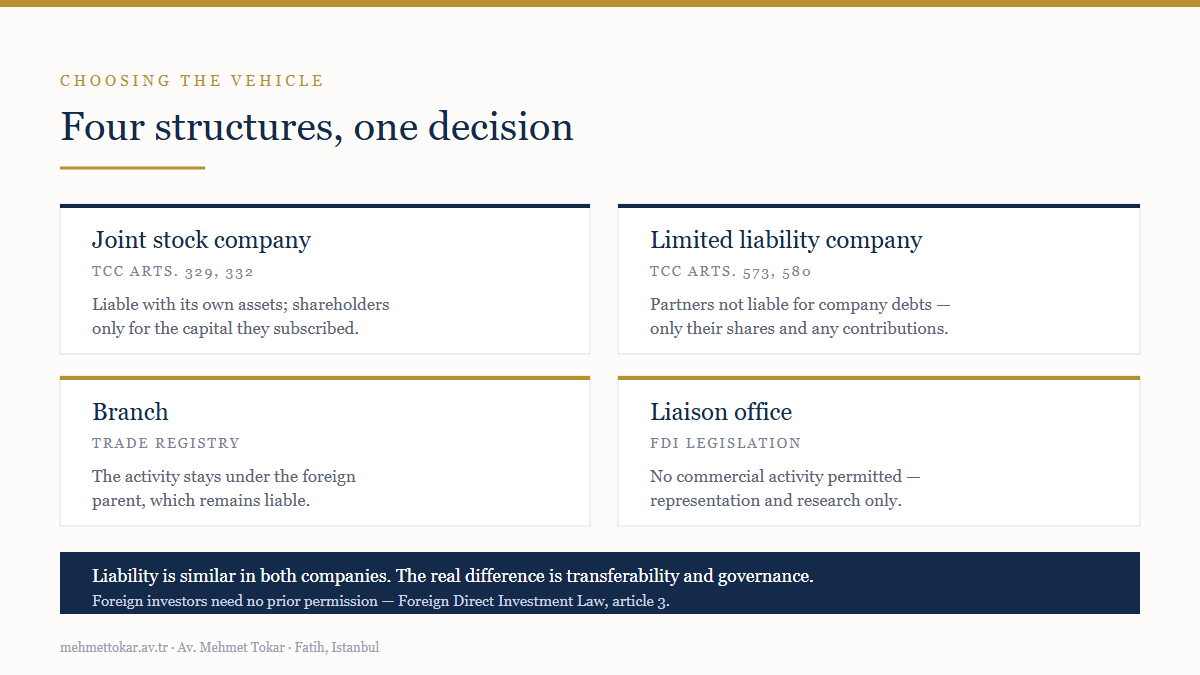
The practical difference is rarely liability, which is similar in both. It is transferability, governance and how the business expects to raise money. A joint stock company handles share transfers and later investors more easily; a limited liability company suits an owner-managed business with a stable partner list.
Holding Real Estate Through the Company
One point matters where the company will hold real estate. Under Article 36 of the Land Registry Law, a company established in Turkey in which foreign persons hold fifty per cent or more of the shares, or can appoint or remove the majority of those with management rights, may acquire immovable property in order to carry on the activities stated in its articles of association. The articles should therefore describe the intended activity in terms wide enough to cover the acquisition.
Branches and liaison offices are different animals. The branch keeps the activity under the foreign parent, which remains liable. Liaison offices are permitted under Article 3 of the Foreign Direct Investment Law expressly on condition that they carry on no commercial activity in Turkey, and using one as a trading presence creates problems that surface at the first tax inspection.
Company Formation in Turkey: Capital, Articles and Registration
Company formation in Turkey requires capital. The Commercial Code sets base minimums — Article 332 for joint stock companies and Article 580 for limited liability companies — and empowers the President to raise them, up to tenfold in the case of a limited liability company. Those powers have been exercised, so the amount that governs an incorporation is the figure in force on the date of registration rather than the base figure printed in the Code.
The articles of association do more work than founders expect. Signature authority, board or manager appointment, transfer restrictions on shares, quorum and majority rules, and the arrangements for deadlock all belong there. Correcting them later means a general assembly resolution and a further registration.
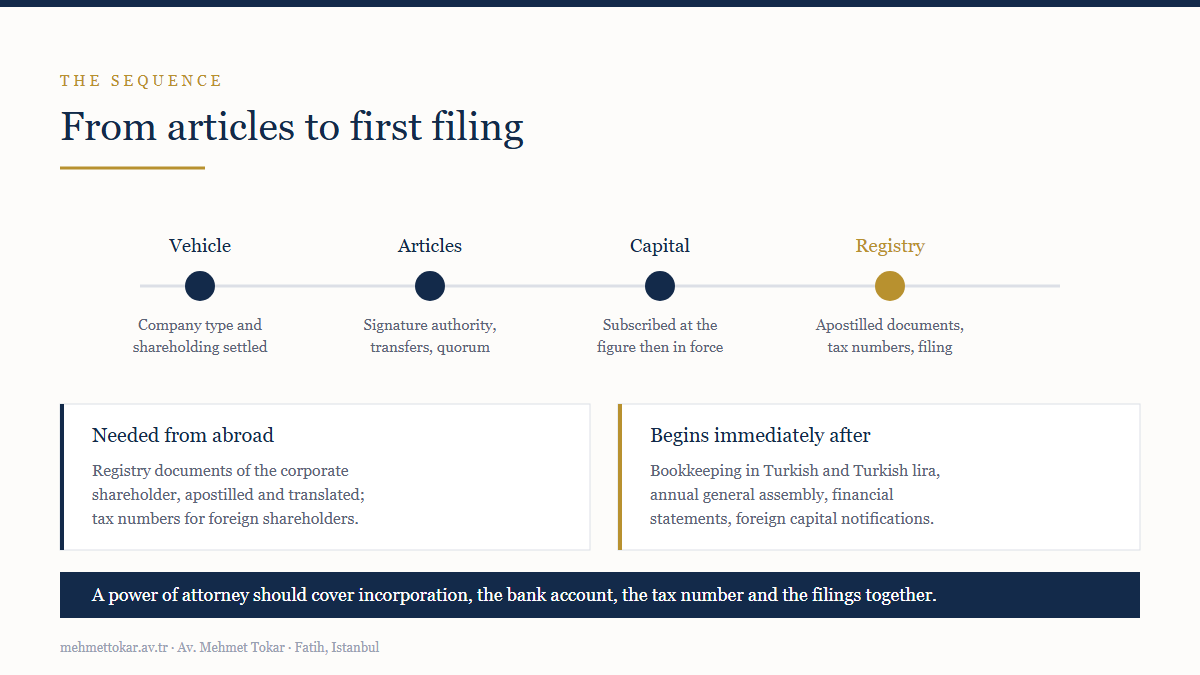
Registration with the trade registry completes company formation in Turkey. A foreign corporate shareholder produces its own registry documents, apostilled and translated by a sworn translator, and foreign shareholders and directors obtain a Turkish tax identification number. Where the founders are abroad, the whole process can be conducted under a power of attorney that expressly covers incorporation.
After Company Formation in Turkey: The Duties That Begin
Company formation in Turkey brings immediate obligations. Bookkeeping starts at once, and Article 215 of the Tax Procedure Law requires the books and records to be kept in Turkish and the Turkish currency to be used in records and documents; entries in another language are permitted only alongside the Turkish ones. Statutory books are certified, invoices and records are kept in the forms prescribed, and the accounting is not something to be organised at the end of the first year.
Corporate governance follows its own calendar: an annual general assembly, financial statements, and the resolutions and filings that go with them. Directors and managers carry personal responsibility for some of these obligations, which is why passive nominee appointments are a poor idea.
Companies carrying foreign capital have additional notification duties under the foreign investment legislation, including periodic information on capital and shareholding. These are administrative rather than onerous, but they are checked.
Where Foreign Founders Run Into Difficulty
Three patterns recur in company formation in Turkey. The first is a mismatch of identity details between the passport, the apostilled corporate documents and the registry application — the same problem that delays property transfers, and it delays incorporations for the same reason.
The second is a power of attorney drafted too narrowly. Company formation in Turkey involves several distinct acts, and an authority that mentions only “establishing a company” may not cover opening the bank account or obtaining the tax number.
The third is choosing the vehicle to match a template rather than the business. Where a second investor is expected within two years, choosing a limited liability company for the sake of a lower capital figure creates a restructuring cost that dwarfs the saving.
A Practical Sequence
Settle the vehicle and the shareholding before anything else in company formation in Turkey, before any document is drafted, because both determine what the articles must contain.
Obtain tax identification numbers for foreign shareholders and directors early — they are needed for the bank account and the registration.
Draft the articles for the business as it is expected to develop, not only as it starts. Share transfer restrictions and signature authority are the two provisions most often revisited.
Prepare the power of attorney to cover incorporation, the bank account, the tax number and the registry filings together, so that a single document carries the whole process.
What Company Formation in Turkey Turns On
The legal framework is not the obstacle. Article 3 of the Foreign Direct Investment Law guarantees freedom to invest, equal treatment, protection against uncompensated expropriation, free transfer of proceeds and access to arbitration. Against that background, company formation in Turkey is an ordinary corporate exercise governed by the Commercial Code.
The decisions that matter are made before anything is filed. Choosing between a joint stock and a limited liability company determines how shares move and how the company is governed. Drafting the articles determines what can be done without a further registration. And confirming the capital figure in force on the day avoids the most common false start, since the base amounts in the Code have been raised by presidential decision. Where the founders are outside Turkey, a single well-drafted authority covering incorporation, banking and registration turns the whole process into a matter of weeks rather than trips.
Frequently Asked Questions
Do foreign investors need permission for company formation in Turkey?
No. Article 3 of the Foreign Direct Investment Law provides that foreign investors are free to make direct investments and are subject to equal treatment with domestic investors, unless international agreements or special statutes provide otherwise.
Which company type suits company formation in Turkey?
Company formation in Turkey uses two main forms. A joint stock company suits businesses expecting share transfers or later investors; a limited liability company suits owner-managed structures. Liability is similar in both — the difference lies in governance and transferability.
How much capital is required?
For company formation in Turkey the Commercial Code sets base minimums in Articles 332 and 580 and allows the President to increase them. Those powers have been used, so the amount in force on the date of registration is the one that governs.
Can I set up a company without coming to Turkey?
Yes. Company formation in Turkey can be completed under a power of attorney that expressly covers incorporation, the bank account, the tax number and the registry filings. A narrowly drafted authority is the usual reason a remote incorporation stalls.
Can profits be transferred abroad?
Yes. Article 3 of the Foreign Direct Investment Law allows net profits, dividends, sale and liquidation proceeds, compensation and licence or management fees to be transferred freely through banks or financial institutions.
What is the difference between a branch and a liaison office?
A branch carries on the parent’s activity in Turkey and the parent remains liable. A liaison office may not carry on commercial activity at all and is limited to representation and market research.
Contact
You can write to hukuk@mehmettokar.av.tr or use the contact page. For the wider framework see Legal Services for Foreigners in Turkey; for acting from abroad see Power of Attorney in Turkey; and for the residence side see Residence Permit in Turkey. Official source: mevzuat.gov.tr. The office is in Fatih, Istanbul.