

Medical Law Lawyer · Practice Area
A medical law lawyer comes into the picture after the law has already assumed responsibility where medicine reaches its limits. From clinical negligence to patients’ rights, and from medical practitioners’ liability to compensation, we provide legal assistance across all areas of healthcare law.
Legal remedies for individual patients and their relatives; defence and preventive legal advice for medical practitioners and healthcare institutions.
Compensation for harm arising from diagnostic, surgical and medication errors.
- Distinction from complications
- Misdiagnosis
- Caesarean section negligence
- Cosmetic surgery
- Dentistry
- Eye surgery
Informed consent, privacy and the protection of health data.
- What are patients’ rights?
- Consent for minors
- Personal health data
- Records of deceased persons
- Involuntary treatment
- Right to confidentiality of HIV status
Civil and criminal liability of medical practitioners, hospitals and healthcare personnel.
- Criminal liability
- Nurses and doctors’ orders
- Hospital-acquired infection
- Professional Liability Board (Mesleki Sorumluluk Kurulu)
- Violence against healthcare workers
- Pharmacists’ liability
Claims for pecuniary and non-pecuniary damages and loss of dependency damages (destekten yoksun kalma tazminatı).
- Claim for pecuniary damages
- Chemotherapy error
- Delayed cancer diagnosis
- Neglect in nursing homes
- Non-pecuniary damages
- Refund of excessive charges
What Does a Medical Law Lawyer Do?
A medical law lawyer can represent both patients and medical practitioners in disputes arising from medical interventions. The first step is to distinguish between a complication and clinical negligence using medical and legal criteria.
Preparing the case begins with the comprehensive collection of hospital medical records, consent documents and medical test results. The lawyer reviews the expert report against these documents, examines fault and the causal link, and arranges for the assessment of the heads of damages. For the administrative framework governing medical practitioners’ professional liability, saglik.gov.tr may be consulted as a reference.
Medical law is the branch of law that examines legal relationships arising from the provision of healthcare services, patients’ rights, medical practitioners’ liability and the legal limits of medical interventions. It covers a broad spectrum, from the relationship between patients and medical practitioners to the liability of hospital management, and from the obligations of pharmaceutical companies to the legal framework governing healthcare policies. At Tokar Hukuk, our team working in medical law provides comprehensive legal assistance to clients in clinical negligence claims, violations of patients’ rights, medical practitioners’ liability and medical compensation proceedings.
What Is Medical Law?
Medical law is an interdisciplinary field that regulates the legal aspects of medical interventions and defines the rights and obligations of patients and healthcare workers. It is not limited to clinical negligence claims; informed consent, patient privacy, access to medical records, mandatory reporting obligations and bioethics also fall within its scope.
In Türkiye, medical law is governed by the Turkish Code of Obligations (Türk Borçlar Kanunu), the Turkish Criminal Code (Türk Ceza Kanunu), the Regulation on Patients’ Rights (Hasta Hakları Yönetmeliği), the Law on the Practice of Medicine and Its Branches (Tababet ve Şuabatı San’atlarının Tarzı İcrasına Dair Kanun) and related regulations. Decisions of the Court of Cassation (Yargıtay) and the Council of State (Danıştay) also provide fundamental guidance for legal practice in this field.

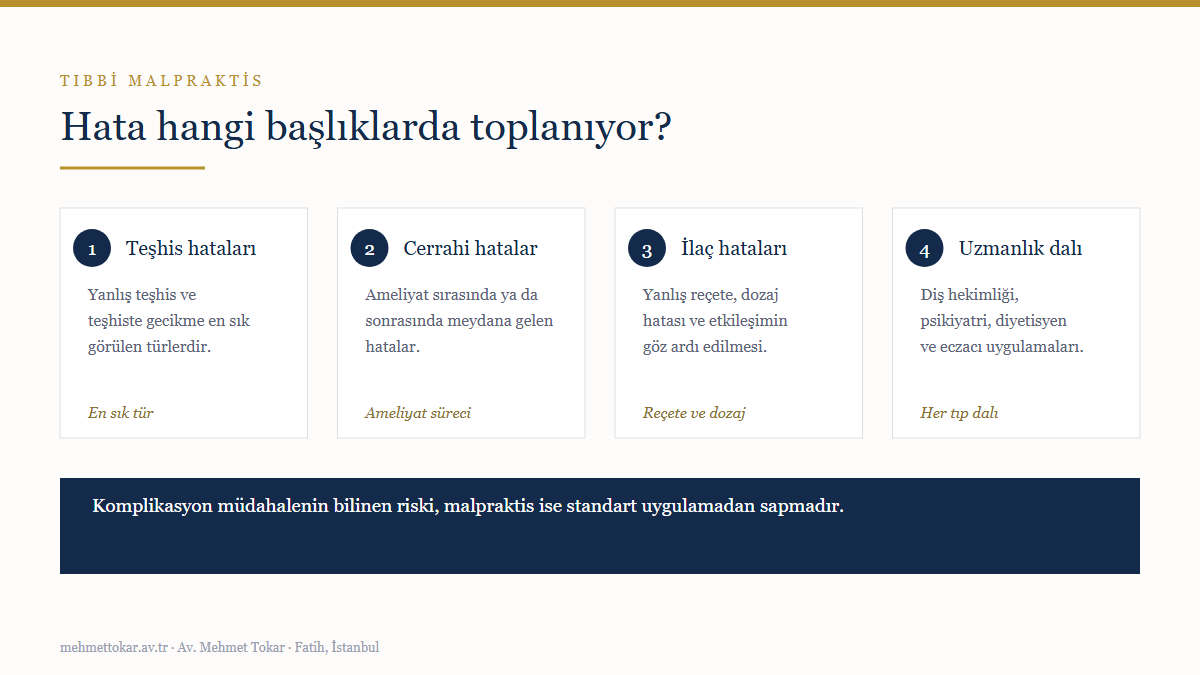
Clinical Negligence (Medical Error)
Clinical negligence refers to medical practices resulting from a medical practitioner’s lack of knowledge, lack of experience or negligence that cause harm to a patient. The distinction between clinical negligence and complicationsis crucial in determining legal liability: a complication is a known and foreseeable risk of a medical intervention, whereas clinical negligence involves a departure from standard medical practice.
Diagnostic Errors
Misdiagnosis and delayed diagnosis are among the most common forms of clinical negligence. For a compensation claim for misdiagnosis to be brought, the diagnostic error must have adversely affected the treatment process and caused harm to the patient. Cases of delayed cancer diagnosis are among the examples of clinical negligence with the most serious consequences in this field.
Surgical Errors
Errors occurring during or after an operation fall within the scope of surgical negligence. Cosmetic surgery negligence,, ophthalmic surgery errors,, Caesarean section negligence and obstetric negligence are significant subjects of litigation in this field.
Medication Errors
Prescribing the wrong medication, making dosage errors or overlooking drug interactions can have serious consequences. Adverse drug effects and legal liability and compensation for chemotherapy errors are legal issues arising from medication-related harm. Medication errors in nursing practice are also considered within this scope.
Clinical Negligence by Medical Discipline
Clinical negligence claims may arise in almost every branch of medicine. Dental negligence,, psychiatric negligence,, dietetic negligence and pharmacist negligence are examples of errors arising in different healthcare professions that also fall within the scope of medical law.
Patients’ Rights
Patients’ rightsare the fundamental rights of every individual receiving healthcare services. These rights are protected under the Regulation on Patients’ Rights, and their violation gives rise to legal liability.
Informed Consent
Medical practitioners are obliged to provide patients with understandable information about the risks, alternatives and possible consequences of the proposed intervention. Failure to fulfil this obligation may give rise to legal liability even if the intervention is successful. Consent to medical treatment of minors constitutes a distinct aspect of informed consent.
Patient Privacy and Health Data
The confidentiality of patient information is protected under both the Regulation on Patients’ Rights and the Personal Data Protection Law (Kişisel Verilerin Korunması Kanunu, KVKK). The right to confidentiality of HIV status,, psychologists’ duty of confidentiality and the protection of personal health data are critical issues in this field. Access to a deceased person’s medical records is also among the most frequently raised legal issues.
Civil Liability of Medical Practitioners and Healthcare Institutions
Liability for harm arising from medical interventions is considered at different levels: the individual liability of the medical practitioner, the institutional liability of the healthcare institution and the liability of the public authority in the case of state hospitals.
Medical Practitioners’ Liability
The legal liability of medical practitioners is considered in two respects: civil liability (compensation) and criminal liability. The criminal liability of medical practitionersarises in connection with the offences of causing injury or death by negligence. Doctors’ rights encompass the legal protections afforded to medical practitioners in their professional practice. The state’s right of recourse against healthcare workersconstitutes a distinct aspect of liability for medical practitioners working in public hospitals.
Liability of Healthcare Institutions
Hospitals bear institutional responsibility for the actions of their employees and the quality of the services provided. A hospital-acquired infection compensation claim,, neglect in nursing homes and the civil liability of nurses illustrate different aspects of institutional liability.
Nurses and Other Healthcare Personnel
Liability in healthcare services is not limited to medical practitioners. Liability for carrying out doctors’ orders in nursing practice and negligent monitoring of chronic conditions are issues that define the respective areas of responsibility of each profession in healthcare delivered by a team.

Medical Compensation Claims
Patients harmed by medical interventions or their relatives may claim pecuniary and non-pecuniary damages. The main points to consider when bringing a claim for damages are:
- Pecuniary damages: Tangible losses such as medical treatment expenses, loss of working capacity, care costs and loss of income.
- Non-pecuniary damages: Damages claimed for pain, suffering and reduced quality of life.
- Loss of dependency damages: Financial losses suffered by relatives following the patient’s death.
In a claim for pecuniary damages arising from clinical negligence, a report from the Council of Forensic Medicine (Adli Tıp Kurumu) or university panels of experts must be obtained to establish fault. The Professional Liability Board (MSK) also plays an important role in this process. Refunds of excessive private hospital charges may arise as a separate compensation issue.
Legal Remedies
Judicial remedies available in medical law cases:
- Civil court: Claims for damages against private healthcare institutions and self-employed medical practitioners.
- Administrative Court (İdare Mahkemesi): Full remedy action (tam yargı davası) against state hospitals and public healthcare institutions.
- Criminal court: Criminal proceedings concerning offences of causing injury or death by negligence.
- Consumer Court (Tüketici Mahkemesi): Consumer disputes involving private healthcare institutions.
Current Issues in Medical Law
Medical law is a constantly evolving field. Issues of particular relevance today include:
- Involuntary treatment and mental health law: The legal limits of involuntary interventions in addiction treatment.
- Organ transplantation and organ trafficking: Legal framework and criminal liability.
- Euthanasia and end-of-life decisions: Ethical and legal aspects.
- Clinical negligence in medical tourism: The rights of foreign patients in Türkiye.
- Violence against healthcare workers: Increasing numbers of incidents and legal protection mechanisms.
- Medicines not covered by the Social Security Institution (Sosyal Güvenlik Kurumu, SGK): Legal application procedures concerning cancer treatment.
Our Medical Law Services
The main services we provide at Tokar Hukuk in the field of medical law are:
- Clinical negligence claims: Handling claims for damages arising from diagnostic errors, surgical errors, medication errors and all forms of medical negligence.
- Violations of patients’ rights: Legal advice on matters such as failure to obtain valid informed consent, breaches of privacy and refusal of treatment.
- Defence of medical practitioners and institutions: Legal defence of healthcare workers and institutions against unfounded allegations.
- Assessment of damages: Assessment of pecuniary and non-pecuniary damages and development of litigation strategies.
- Applications to public authorities: Managing applications to Patients’ Rights Boards (Hasta Hakları Kurulları), the Ministry of Health (Sağlık Bakanlığı) and SGK.
- Review of expert reports: Legal analysis of expert reports issued by the Council of Forensic Medicine and universities.
At our Istanbul-based office, with the assistance of a clinical negligence lawyer,, an Istanbul medical law lawyer and a medical compensation lawyer, we provide legal services to our clients. For your medical law cases and legal questions, you may contact us.
Frequently Asked Questions
What is the limitation period for bringing a clinical negligence claim?
The limitation period for clinical negligence claims is 5 years from the date on which the harm becomes known and, in any event, 20 years from the date of the act. If the act constitutes a criminal offence, the criminal limitation period applies and may be longer.
Who should be sued for clinical negligence occurring in a state hospital?
For medical errors occurring in state hospitals, proceedings cannot be brought directly against the medical practitioner; a full remedy action is brought before the Administrative Court against the relevant healthcare institution (the Ministry of Health or the university). After paying compensation, the public authority may exercise its right of recourse against the medical practitioner at fault.
Which court has jurisdiction over clinical negligence occurring in a private hospital?
For medical errors occurring in private hospitals, proceedings may be brought before the Consumer Court or the Civil Court of First Instance (Asliye Hukuk Mahkemesi). The claim may be brought against the hospital, the medical practitioner or both.
Who bears the burden of proof in a clinical negligence claim?
As a general rule, the patient bears the burden of proof. However, the case law of the Court of Cassation may place the burden of proof on the medical practitioner in matters involving failure to obtain valid informed consent and the management of complications. In cases of hospital-acquired infection, the hospital must prove the absence of fault.
How long does a medical law case take?
The duration of proceedings varies depending on the court’s workload, the expert report process and the stages of challenge. On average, proceedings may take 1-3 years before the court of first instance and 3-5 years including appeals (istinaf) and appeals on points of law (temyiz).